
Washington Rate Watch
PSE rate hikes, Olympia policy, and Washington’s shrinking power-price advantage
Puget Sound Energy customers started 2026 with higher bills. Then came a new three-year rate filing. The official record shows a mix of climate-compliance costs, clean-energy transition spending, reliability investments, and growing demand. The practical result for households is simpler: more pressure on monthly power bills in one of the country’s already expensive states.
What changed on Jan. 1, 2026
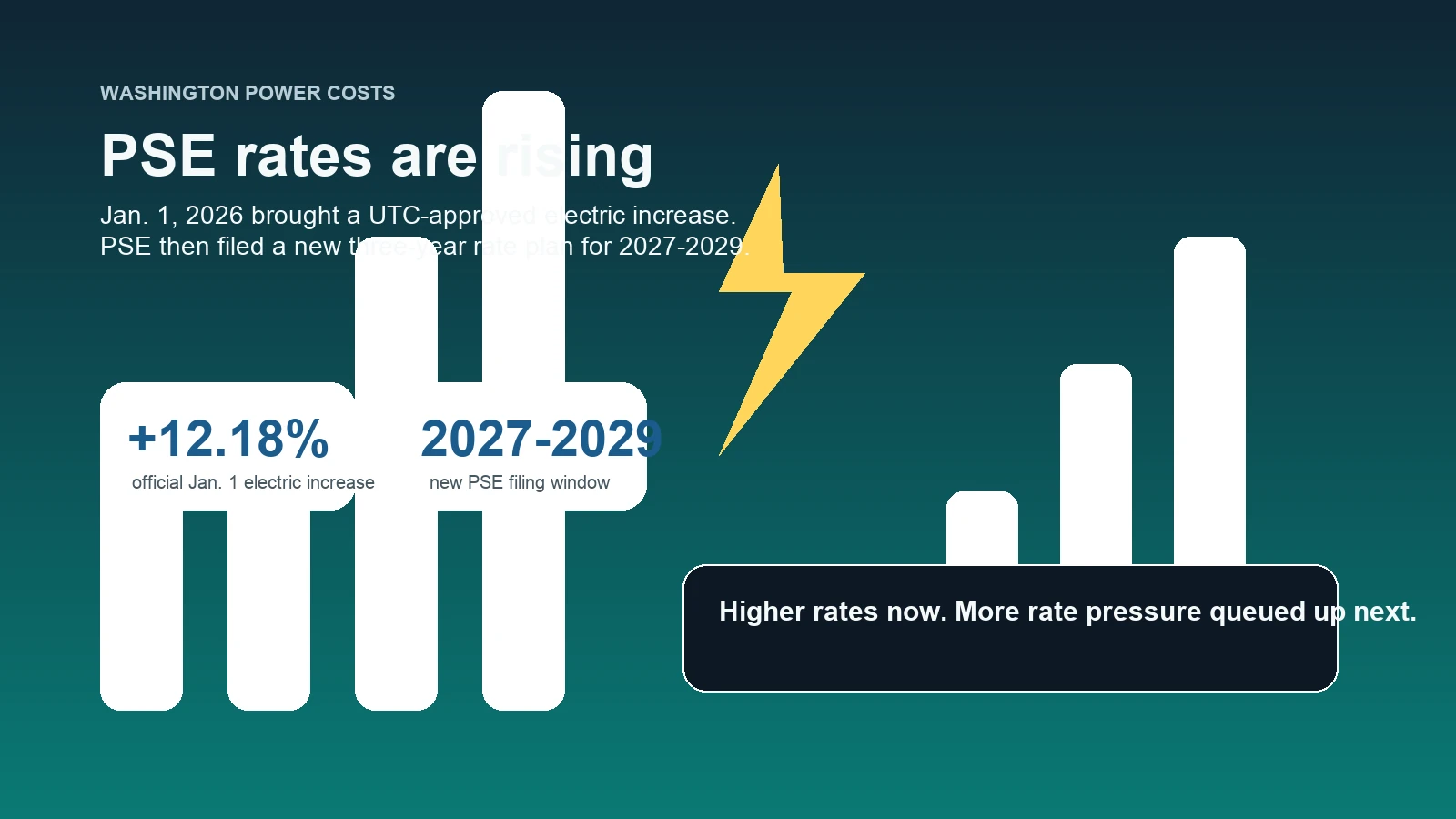
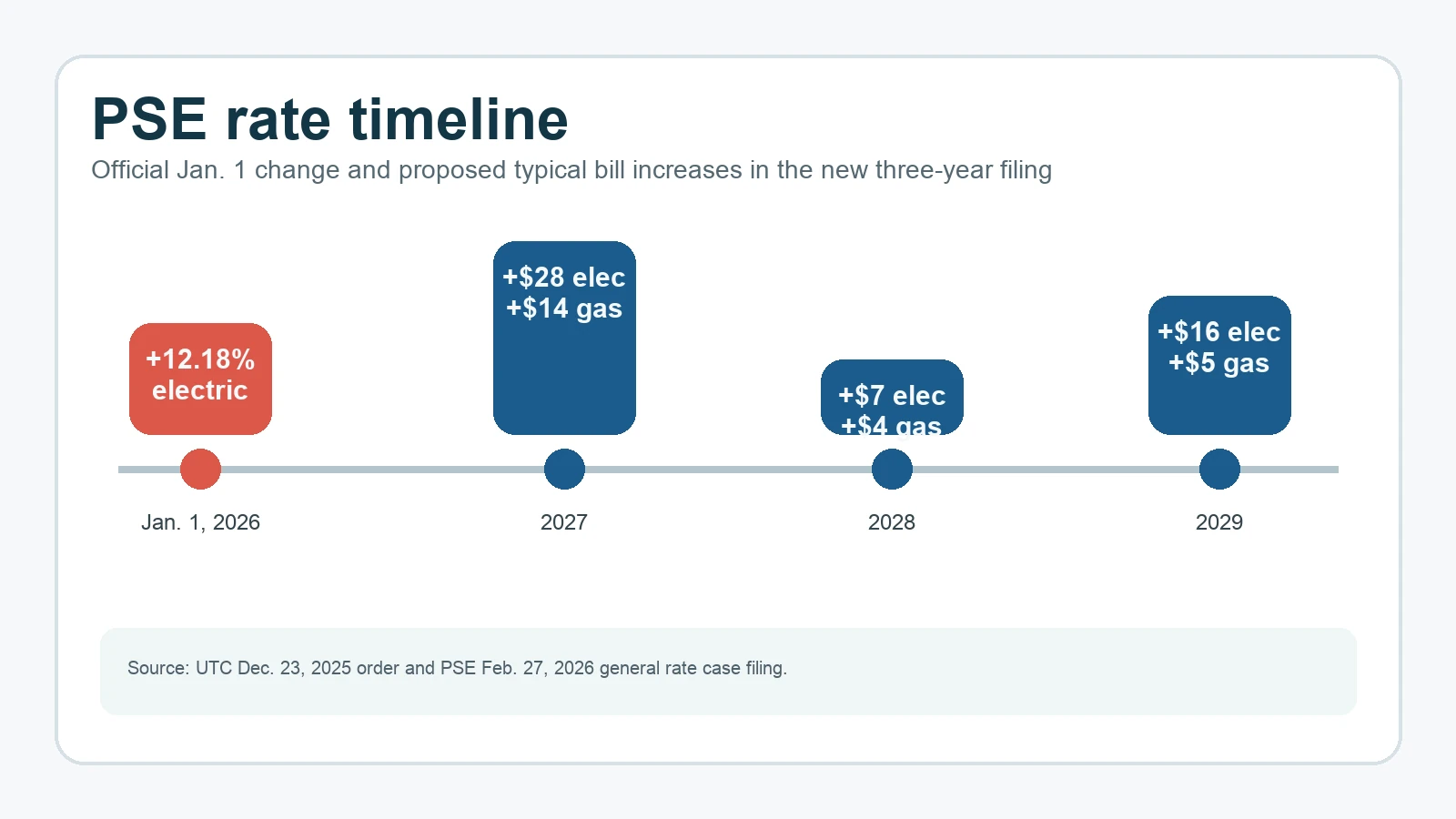
The official Jan. 1 increase approved by the Washington Utilities and Transportation Commission was a 12.18% net increase for the average residential electric customer, or about $16.84 more per month for a household using 800 kWh. Natural gas customers saw a 6.68% net increase, or about $6.59 more per month for a customer using 64 therms.
Electric
+12.18%
Roughly $16.84 more per month for the average residential customer, according to the UTC.
Natural Gas
+6.68%
Roughly $6.59 more per month for the average residential customer, according to the UTC.
At a Jan. 21, 2026 House Agriculture & Natural Resources hearing on HB 2275, PSE Senior Vice President Matt Steuerwalt was later summarized by House Republicans as saying PSE had “just raised rates 13%” because of green-energy laws. That statement appears to be a rounded political characterization; the UTC’s published Jan. 1 order put the official net electric increase at 12.18%.
What PSE wants next
On Feb. 27, 2026, PSE filed a new three-year general rate case with the UTC. PSE says the request is meant to fund reliability and safety work, new generation and transmission, growing demand, and compliance with Washington clean-energy requirements. If approved, the proposal would affect bills in 2027, 2028, and 2029.
Typical residential electric bill
- About $28 more per month in early 2027
- About $7 more per month in 2028
- Nearly $16 more per month in 2029
Typical residential natural gas bill
- About $14 more per month in early 2027
- About $4 more per month in 2028
- Nearly $5 more per month in 2029
Why this lands so hard in Washington
Washington is not starting from an easy cost baseline. Federal price-level data from the Bureau of Economic Analysis puts Washington among the most expensive places in the country. At the same time, the state has historically benefited from relatively low electricity prices thanks in large part to legacy hydro resources. That advantage has not disappeared, but the gap is tightening.
Affordability context
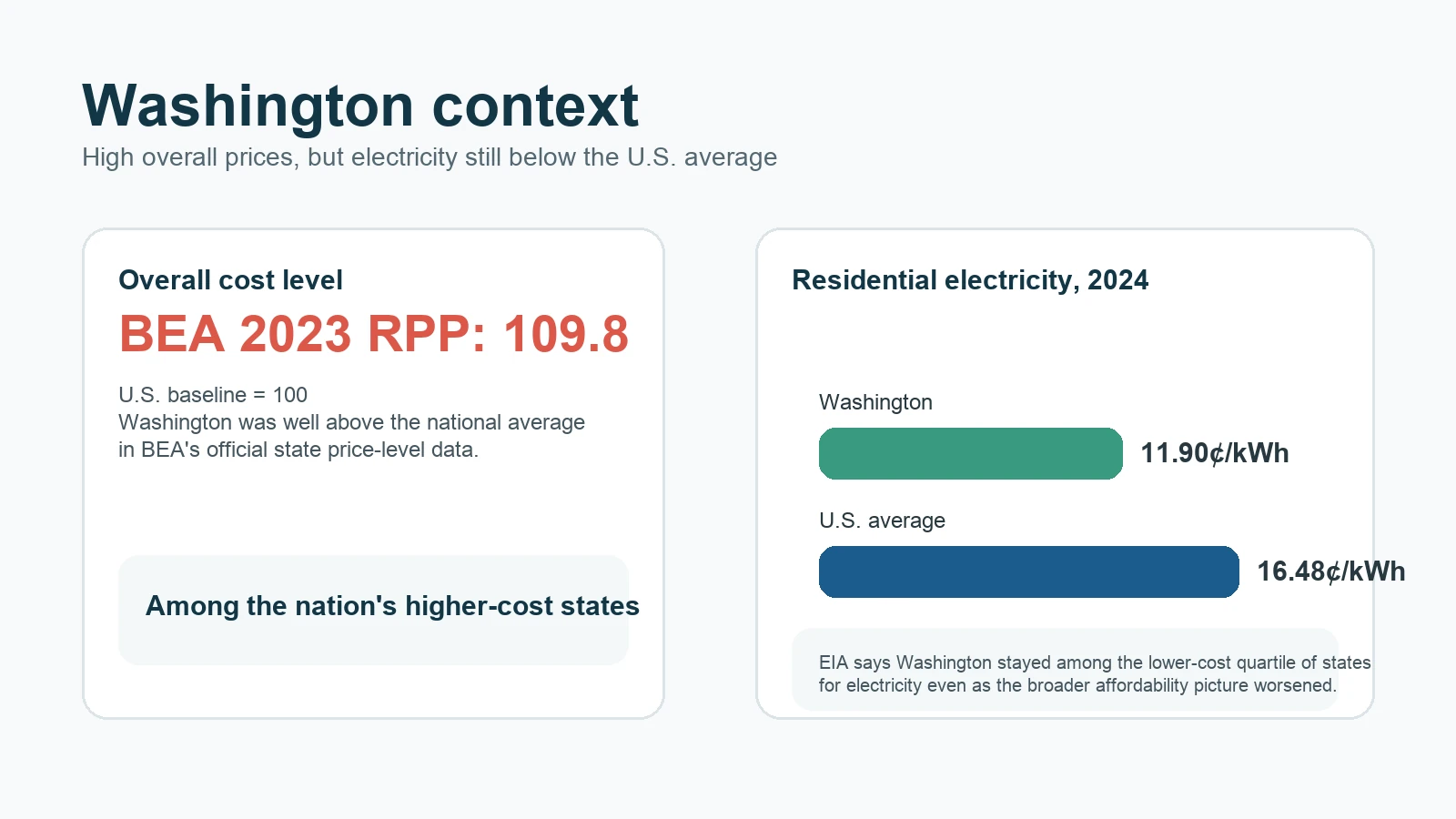
BEA’s 2023 Regional Price Parities report put Washington’s all-items price level at 109.8, well above the national baseline of 100. In 2024, BEA still listed Washington among the country’s higher-cost states, behind California, Hawaii, and New Jersey.
Electricity context
EIA’s Washington electricity profile says the state’s 2024 average retail price was 10.13 cents per kWh overall, ranking 39th nationally, and the profile notes Washington remained among the lower-cost quartile of states. EIA’s 2024 table shows Washington residential power at 11.90 cents per kWh versus a U.S. average of 16.48 cents.
What the filings actually say
PSE and regulators do not frame these increases as a single-policy story. The UTC said the Jan. 1, 2026 changes were tied to a combination of Climate Commitment Act compliance, expanding clean energy, reliability and safety investments, and low-income bill-discount costs. PSE’s new 2026 general rate case says the company needs billions more in gas and electric system investment over 2027-2029, with roughly 70% of that spending aimed at the electric system.
That matters because any serious conversation about rising rates needs to separate political attribution from the official cost stack. The politics are real. So are the bills. But the source documents show multiple drivers moving at once: climate compliance, new capacity, hardening infrastructure, safety, and load growth.
Why Idaho homeowners, especially in the north, should pay attention
Washington’s rate hikes do not automatically roll into Idaho bills. Idaho has its own regulators and utilities. But North Idaho is not electrically isolated from Washington. The stronger claim supported by the public record is this: North Idaho customers share parts of the same regional power system, the same hydro-heavy backbone, and many of the same wholesale and infrastructure pressures. That makes Washington’s trend line relevant even when the legal rate cases are separate.
How the power system overlaps
- Avista serves customers in eastern Washington and northern Idaho as one integrated utility system.
- Avista’s 2024 electric resource mix was still heavily shaped by hydro generation and wholesale contracts, with hydro the single largest component.
- Avista’s transmission system is interconnected with the Bonneville Power Administration grid, which helps move hydro and other regional power across state lines.
Why Washington still matters
- When regional clean-energy rules, transmission buildouts, or reliability investments raise system costs in Washington, they can also affect the market prices and capital plans utilities around the Northwest have to navigate.
- Idaho regulators have already been tracking this connection: in Avista’s Idaho multi-year rate case, Idaho Public Utilities Commission staff specifically asked for updates on how Washington’s Climate Commitment Act could affect Idaho customers.
- That does not prove a dollar-for-dollar pass-through. It does show the spillover question is real enough that Idaho regulators put it into the record.
The clearest overlap is Avista territory in North Idaho. Avista’s own 2023 Washington IRP progress report describes a system anchored by regional hydro projects including Spokane River dams and Cabinet Gorge and Noxon on the Clark Fork, then notes Avista’s 230-kV transmission system interconnects with BPA’s 500-kV system at multiple points. In plain English: power serving North Idaho homes is part of a wider Washington-Idaho-Montana network, not a sealed local island.
Other North Idaho homeowners are in a somewhat different position. Cooperatives such as Kootenai Electric and Northern Lights say a large share of their power comes from BPA’s federal hydro system. That can provide some insulation compared with investor-owned utility customers who are more exposed to their utility’s own rate cases. But it does not make those areas immune. If the broader Northwest needs more transmission, more replacement capacity, or more market purchases during tight periods, BPA-dependent utilities can still feel that pressure through wholesale costs, contract terms, and future power-supply planning.
Best-supported forecast: North Idaho is more likely to import Washington’s cost pressure indirectly through shared wholesale markets, transmission needs, and utility capital spending than through a simple one-line pass-through from PSE bills. Avista customers in Idaho are the most exposed to that pattern because Avista operates across both states, while BPA-heavy co-op customers may feel it later and through different mechanisms.
What to watch next in Idaho
Idaho homeowners who want an early warning sign should watch Avista Idaho filings and BPA contract and cost developments, not just Washington headlines. Avista’s January 2025 Idaho multi-year filing proposed residential electric bill increases in 2025 and 2026, and its February 2026 annual power-cost adjustment filing sought another residential increase. Those are Idaho-specific proceedings, but they reinforce the same broader point: the inland Northwest is dealing with a tightening cost environment, not a Washington-only story.
Bottom line
Washington households once had a stronger electricity-cost advantage than most of the country. The official filings show that edge is under pressure. Idaho homeowners, especially in Avista-served North Idaho, should not assume they are outside that story. They are on a different regulatory track, but they are tied into much of the same regional grid, hydro backbone, and cost pressure pushing the inland Northwest toward higher power bills.
Sources
- Washington Utilities and Transportation Commission, State regulators approve multiple orders impacting Puget Sound Energy rates, Dec. 23, 2025.
- TVW, House Agriculture & Natural Resources Committee, Jan. 21, 2026 hearing on HB 2275.
- wa-law.org bill tracker for HB 2275, showing Matt Steuerwalt of Puget Sound Energy testifying before the Jan. 21, 2026 committee hearing.
- Washington House Republicans, Capitol Buzz, Jan. 2026 summary describing Steuerwalt’s hearing remarks.
- Puget Sound Energy, 2026 General Rate Case, filed Feb. 27, 2026.
- Washington Utilities and Transportation Commission docket page for PSE’s consolidated 2026 general rate case, UE-260005 and UG-260006.
- U.S. Bureau of Economic Analysis, Regional Price Parities by State and Metro Area, 2024 release and Dec. 14, 2023 table.
- U.S. Energy Information Administration, Washington Electricity Profile 2024 and 2024 average retail price table.
- Avista Corp. 2024 Annual Report / Form 10-K, resource mix and utility operations.
- Avista, 2023 Washington Electric IRP Progress Report, generation and transmission system overview.
- Idaho Public Utilities Commission, Avista Idaho multi-year rate plan case documents and annual power-cost adjustment filing materials.
- Bonneville Power Administration, Provider of Choice and regional power-services materials.
- Kootenai Electric Cooperative and Northern Lights official power-supply / BPA resource information.