
KEC peak demand, visualized
Tired of KEC’s New Peak Use Charge?
If you have an all-electric home in Kootenai County, you could be paying $200+ per month in demand charges alone. There’s a better way.
What Changed in January 2026
Kootenai Electric Cooperative introduced a new Peak Use Charge that behaves more like a commercial demand fee than a traditional residential electric rate.
Peak Window
6-10 AM
5-9 PM
KEC looks at your highest single-hour draw during those windows. That one spike can set the charge for your whole month.
Demand Price
$6 / kW
above 5 kW
The first 5 kW is free. Every extra kW during your highest peak hour adds cost fast, especially in an all-electric home.
Who Gets Hit
All-Electric
Homes
If your heat, hot water, cooking, and appliances all run on electricity, your peak demand is much higher and KEC makes no distinction.
Why All-Electric Homes Can See Higher Peak Charges
This side-by-side example shows how overlapping electric loads can create a much higher KEC peak demand than a similar home using gas for major heating loads.
That’s an extra $2,376 per year just for being all-electric, before you even count the electricity you actually use. Add an EV charger or 400-amp service and it gets worse.
Peak Use Charge Calculator
Check the loads that can overlap during KEC’s peak windows. We’ll estimate your monthly demand charge, what a battery could save, and how many kW of peak power you would need to shave.
Heating & Hot Water
Kitchen
Other Major Loads
Baseline Loads (lights, fridge, electronics)
Additional Load (optional)
With a battery peak shaving system capping your grid demand at 5 kW:
saved per year in demand charges alone, while the battery covers the kW above KEC’s 5 kW threshold
Estimate values were updated against DOE, PG&E electrification/load guides, and manufacturer mini-split specs. Actual peak demand depends on what runs at the same time during KEC’s peak windows.
The Solution: Battery Peak Shaving
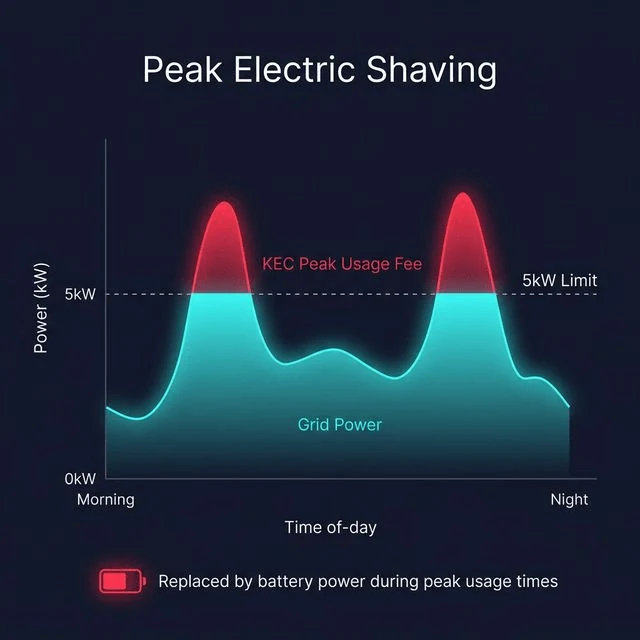
A battery system charges during off-peak hours and takes over during peak windows, keeping your grid demand at or below 5 kW so you pay $0 in demand charges.
There is a second benefit too: the same battery system can also provide home electrical backup during outages, so you are not only reducing demand charges.
Charge Off-Peak
The battery charges when KEC is not measuring the peak windows.
Cap Grid Draw
During peak hours, the system holds your grid pull to 5 kW or less.
Battery Fills the Gap
The battery supplies the amount above 5 kW so your home still runs normally.
Backup Power Too
The same battery system can also keep critical household loads on during outages.
Why This Makes Financial Sense
Battery peak shaving is not a replacement for solar, it’s an additional financial lever that can strengthen the case for a solar-plus-storage system. Solar cuts your energy charges. Peak shaving cuts KEC’s separate demand penalty. Together, they create a faster path to justifying the capital you are already putting into batteries, inverters, controls, and backup capability.
Stacks with solar
Pair battery peak shaving with solar so you reduce both energy charges and demand charges at the same time.
Faster justification
Demand-charge reduction adds a second savings stream on top of the usual solar value proposition.
Immediate savings
Your first bill after installation can reflect the benefit instead of waiting years for the economics to show up.
Backup included
The same battery that cuts the KEC demand penalty can also keep critical loads running when the grid is down.
Why owners move on this
No lifestyle changes required. Cook dinner at 6 PM, run the heat, charge your car, the battery handles the spike instead of KEC billing you for it.
Who Benefits Most
This solution is especially valuable if you have:
Electric heat, hot water, range, and appliances all stack together during KEC peak windows.
A Level 2 charger can add another 7-10 kW of demand all by itself when it overlaps with other loads.
Bigger homes and bigger panels usually mean bigger simultaneous peaks and more exposure to KEC’s demand charge.
Welders, compressors, pumps, grain dryers, and hot tubs can create expensive demand spikes when they hit at the wrong time.
If your KEC bill now shows a Peak Use Charge over $50/month, a battery system is worth evaluating.
Quick screening rule
If your monthly Peak Use Charge is already over $50, there is usually enough financial pain to justify a serious battery peak-shaving conversation.
Frequently Asked Questions
How does battery peak shaving work with KEC’s rate structure?
KEC measures your highest single-hour grid draw during peak hours (6-10 AM and 5-9 PM). A battery system monitors your grid usage in real time. When your home starts pulling more than 5 kW from the grid during peak hours, the battery automatically supplies the difference. KEC’s meter only sees 5 kW or less, so your Peak Use Charge stays at $0.
How big of a battery system do I need?
There are two sizing questions: power and energy. This calculator shows the peak shaving power in kW, how much load the battery needs to cover above KEC’s 5 kW threshold. Battery capacity in kWh depends on how long those peaks last. During a free consultation, we’ll size both so the system actually works in your home.
Do I need solar panels too?
No. A peak shaving system can work entirely from grid power, charging off-peak and discharging during peak hours. But it also pairs well with solar. Solar helps lower your energy charges, while battery peak shaving helps eliminate KEC’s demand charge.
What about winter when heating demand is highest?
Winter is actually when this system saves you the most money. That’s when electric heating drives the highest peak demand and the biggest demand charges. The battery is sized to handle your worst-case winter peak, so it works year-round.
Will my power still work normally?
Yes. You won’t notice any difference in how your home operates. The switchover between grid and battery power is seamless and automatic. Your furnace, water heater, oven, and every other appliance works exactly as before, you just pay less for it.
Is this the same as a whole-home backup battery?
Similar hardware, different purpose. A peak shaving system is optimized to cycle daily, charging off-peak and discharging during peak hours. But it also provides backup power during outages, giving you two benefits from one investment.
How much does a system cost?
System costs depend on your peak demand and the battery capacity needed. During a free consultation, we’ll calculate your specific demand charge, size the right system, and show you how the demand-charge savings can improve the overall payback for a solar-plus-storage or battery-only project.
Stop Paying KEC’s Demand Penalty
Get a free, no-pressure evaluation of your KEC bill. We’ll show you exactly what a peak shaving system would save you, and whether it makes financial sense for your home.
(208) 244-7304
Serving KEC customers in North Idaho